
 English
 中文简体
中文简体 русский
 Español
 عربى
عربى
Industry News


-
+86-15821905003
-
https://www.tiktok.com/@PowerElectronicCapacitor
-
How to Choose a Low Voltage Capacitor for Different Load Conditions
Low voltage capacitors are widely used in electrical distribution systems to improve power factor, support voltage conditions, and manage reactive power demand. They can be installed in industrial plants, commercial buildings, manufacturing facilities, pumping stations, HVAC systems, and other electrical installations.
However, selecting a Low Voltage Capacitor is not simply a matter of choosing the largest capacitance or highest kvar rating available. The capacitor needs to match the system voltage, frequency, load profile, switching conditions, harmonic environment, and installation method.
For manufacturers, electrical contractors, distributors, and industrial buyers, understanding these factors can help avoid capacitor overheating, premature failure, resonance problems, or incorrect power-factor correction.
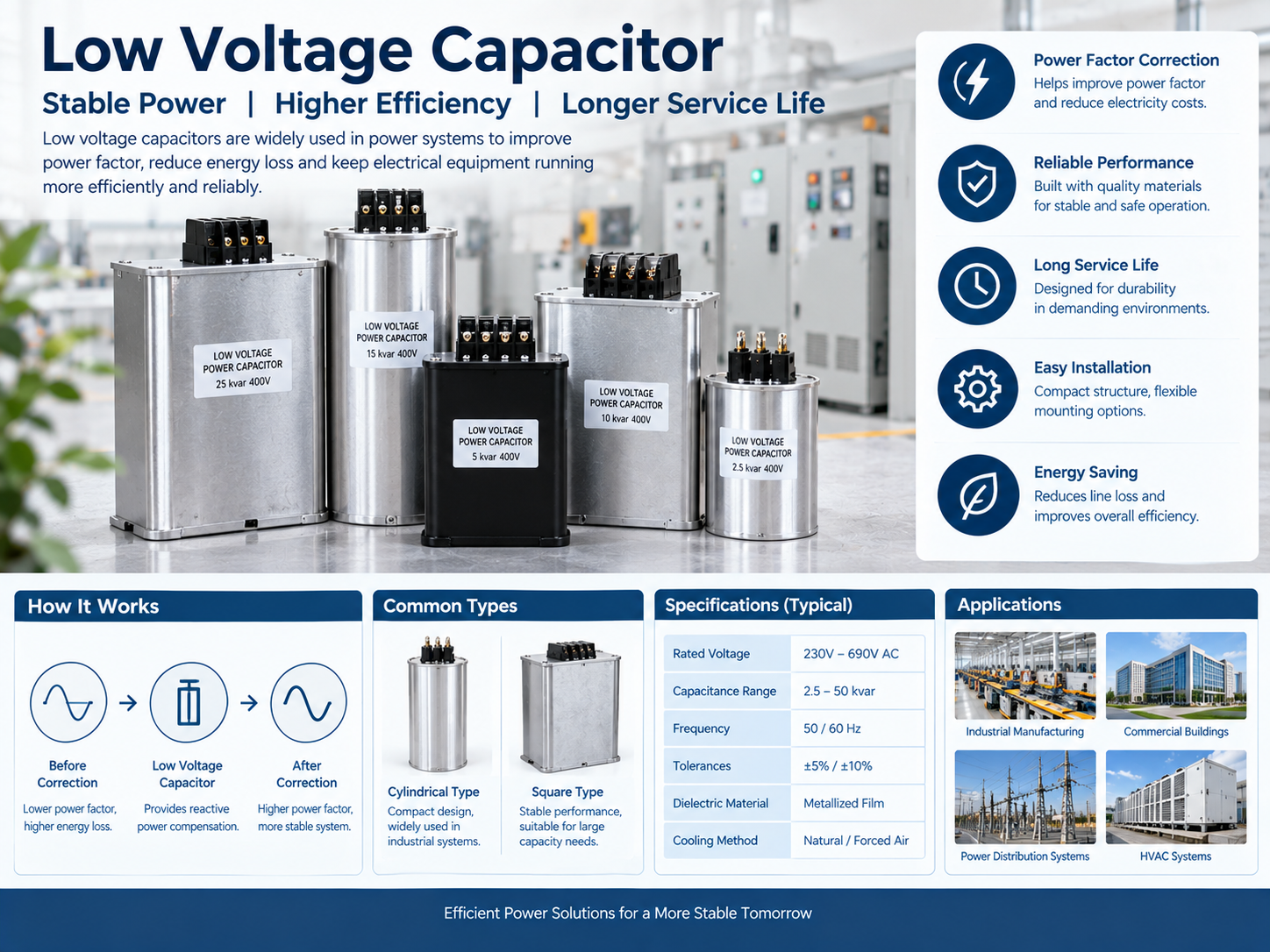
Why Load Conditions Matter When Selecting a Low Voltage Capacitor
Electrical loads do not all behave in the same way.
Induction motors, transformers, pumps, compressors, welding equipment, and HVAC systems can consume significant reactive power. At the same time, variable-speed drives, rectifiers, UPS equipment, and other power-electronic loads can introduce harmonics.
A capacitor suitable for one installation may not be suitable for another because the electrical environment is different.
Before selecting a capacitor, buyers should identify:
- System voltage
- Frequency
- Required reactive power compensation
- Load type
- Load variation
- Harmonic distortion
- Switching frequency
- Installation conditions
- Required operating temperature
These details provide a more useful basis for selection than capacitance alone.
Match the Capacitor Rated Voltage to the Electrical System
Rated voltage is one of the first specifications to check.
A low voltage capacitor should have a rated voltage appropriate for the electrical system in which it will operate. The actual system voltage, allowable voltage variation, and whether the capacitor is connected in a specific three-phase configuration all need to be considered.
Operating a capacitor continuously above its rated conditions can increase electrical and thermal stress.
For B2B buyers, the basic information should include:
| Specification | What to confirm |
|---|---|
| Rated voltage | Matches the intended electrical system |
| Frequency | 50 Hz, 60 Hz, or required system frequency |
| Phase configuration | Single-phase or three-phase |
| kvar rating | Matches reactive-power requirements |
| Overvoltage capability | Check manufacturer specifications |
| Temperature range | Suitable for installation conditions |
The final voltage selection should follow the capacitor manufacturer's technical data and the system design.
Determine the Required kvar Rating
Capacitor banks are commonly specified by reactive power in kvar.
The required compensation depends on the existing and target power factor, as well as the real power consumed by the load.
A commonly used calculation is:
where:
- is the required capacitor reactive power in kvar
- is real power in kW
- corresponds to the existing power factor
- corresponds to the target power factor
For example, if an industrial load operates at a low power factor, adding an appropriately sized capacitor bank can reduce the reactive power supplied through upstream equipment.
However, the calculation should be based on actual operating data. Oversizing the capacitor can create its own problems, particularly when the load changes significantly.
Motor Loads Usually Need Reactive Power Compensation
Induction motors are common in industrial facilities and are a typical application for power-factor correction.
Motors require reactive power to establish their magnetic fields. A capacitor can provide part of this reactive requirement locally.
Common motor-driven loads include:
- Pumps
- Fans
- Compressors
- Conveyors
- Machine tools
- Industrial mixers
The required capacitor rating depends on the motor's loading and operating conditions.
A motor that runs near full load continuously will have different compensation requirements from one that operates at light load or cycles frequently.
For this reason, manufacturers and electrical engineers should use actual load data where possible.
Variable Loads Require a Different Compensation Strategy
Some industrial facilities have loads that change throughout the day.
A fixed capacitor connected to a highly variable load can create insufficient compensation during heavy loading and excessive compensation during light loading.
In these cases, switched capacitor banks may be more appropriate.
A controller can connect or disconnect capacitor stages according to measured system conditions.
| Load pattern | Possible compensation approach |
|---|---|
| Stable load | Fixed capacitor |
| Moderate load variation | Switched capacitor stages |
| Large load variation | Automatic capacitor bank |
| Multiple motor loads | Group or central correction |
| Rapidly changing load | Application-specific dynamic solution |
The control strategy should be selected according to how quickly and how widely the load changes.
Harmonics Can Change the Capacitor Selection
Harmonics are an important consideration in modern electrical systems.
Power electronic equipment such as variable-frequency drives, rectifiers, UPS systems, and switching power supplies can produce harmonic currents and voltages.
Capacitors have lower impedance at higher frequencies, so harmonic currents can flow into capacitor banks. This can increase heating and electrical stress.
In systems with significant harmonic distortion, a detuned or filtered capacitor bank may be considered instead of a basic capacitor bank.
For buyers, useful information includes:
- Total harmonic distortion
- Dominant harmonic orders
- Existing capacitor-bank configuration
- Transformer impedance
- System short-circuit characteristics
A harmonic assessment should be completed before finalizing capacitor specifications when nonlinear loads are significant.
Detuned Reactors May Be Needed in Harmonic-Rich Systems
A capacitor bank can interact with the inductance of transformers and the electrical network. Under certain conditions, this can create resonance near a harmonic frequency.
Detuned reactors are often used with capacitor banks to shift the system's resonance point and limit certain harmonic current effects.
This makes the complete assembly important.
| System condition | Possible consideration |
|---|---|
| Mostly linear loads | Conventional capacitor may be suitable |
| Moderate nonlinear loads | Harmonic evaluation recommended |
| High VFD or rectifier concentration | Detuned capacitor bank may be considered |
| Significant harmonic distortion | Filtered solution may be required |
The actual reactor and capacitor ratings should be determined through system analysis and the manufacturer's engineering data.
Temperature Rating Affects Capacitor Life
Capacitors generate heat during operation, and their environment also affects internal temperature.
High ambient temperatures can accelerate aging of dielectric and other internal components.
Industrial buyers should therefore check:
- Minimum operating temperature
- Maximum operating temperature
- Ventilation requirements
- Heat dissipation
- Enclosure conditions
- Mounting location
A capacitor installed inside a hot electrical cabinet may experience a much higher internal temperature than one installed in a well-ventilated panel.
For long-term reliability, thermal conditions should be considered during system design.
Capacitor Construction Influences Service Performance
Low voltage capacitors are available in different constructions, including various dry-type metallized film designs.
Important construction details can include:
- Dielectric material
- Metallized film
- Self-healing characteristics
- Terminal construction
- Pressure-sensitive disconnection device
- Internal or external protection
The appropriate construction depends on the application and applicable product standards.
For B2B buyers, asking the manufacturer for a technical data sheet and applicable test information provides more useful information than relying on general descriptions.
Self-Healing Technology Can Be Useful
Many modern film capacitors use self-healing technology.
When a localized dielectric fault occurs, the affected area can be isolated through the metallized film structure, allowing the rest of the capacitor to continue operating.
Self-healing does not mean the capacitor can operate indefinitely under any fault condition. Repeated electrical stress can still cause degradation.
A suitable protection system should therefore be used according to the manufacturer's recommendations.
Protection Against Overcurrent and Overvoltage Matters
Capacitor banks need appropriate system protection.
Depending on the installation, protection may include:
- Fuses
- Circuit breakers
- Contactors
- Discharge resistors
- Thermal protection
- Capacitor-duty switching devices
The protection method should correspond to the capacitor rating and installation design.
For switched capacitor banks, contactors specifically designed for capacitor switching may be required to manage inrush currents.
Buyers should confirm the complete protection arrangement with the manufacturer or electrical-system designer.
Switching Conditions Can Affect Capacitor Stress
Energizing a capacitor can produce a transient current.
When multiple capacitor stages are switched, the switching conditions become even more important.
Frequent switching can also create additional thermal and electrical stress.
For applications with regular switching, buyers should ask about:
- Maximum switching frequency
- Recommended contactors
- Inrush-current control
- Stage size
- Controller settings
Properly designed capacitor-switching equipment can help manage these effects.
Different Industrial Loads Require Different Capacitor Priorities
The load type can guide the selection process.
Motors and Pumps
For relatively stable motor loads, the main focus is often the required kvar compensation, voltage rating, and temperature conditions.
Compressors and HVAC Equipment
HVAC systems can operate at different loads throughout the day. Automatic capacitor stages may be useful where the electrical demand changes substantially.
Welding Equipment
Welding equipment can create rapidly changing loads and harmonic effects. Compensation should be evaluated carefully because a simple fixed capacitor may not be appropriate for a highly variable electrical environment.
Variable-Frequency Drives
VFD-based systems contain power electronics and can introduce harmonics. The capacitor solution should therefore be selected only after considering the harmonic environment.
Manufacturing Plants
Factories may have several different load types operating simultaneously. Centralized automatic capacitor banks can sometimes provide more flexible compensation than individual fixed capacitors.
Individual or Centralized Compensation?
Capacitors can be installed close to individual loads, grouped with equipment, or in a centralized distribution panel.
Each approach has different considerations.
| Installation method | Potential advantage | Consideration |
|---|---|---|
| Individual correction | Local reactive-power compensation | More components across the facility |
| Group correction | Suitable for equipment groups | Requires coordinated switching |
| Centralized bank | Easier overall control | Needs appropriate distribution-system design |
The choice depends on the electrical architecture and load behavior.
Capacitor Physical Dimensions Should Fit the Installation
Electrical specifications are only part of procurement.
Industrial buyers also need to confirm:
- Diameter or dimensions
- Terminal arrangement
- Mounting method
- Clearance
- Weight
- Connection orientation
A capacitor with the correct electrical rating may still be unsuitable if it cannot fit the cabinet or mounting structure.
This is especially important when replacing an existing capacitor with a different manufacturer's product.
What Should B2B Buyers Ask a Low Voltage Capacitor Manufacturer?
Before ordering, buyers should provide the manufacturer with complete application information.
| Question | Why it matters |
|---|---|
| What voltage ratings are available? | Supports system matching |
| What kvar ratings are offered? | Helps meet compensation requirements |
| Which frequencies are supported? | Confirms electrical compatibility |
| Is the capacitor self-healing? | Indicates construction characteristics |
| What temperature range applies? | Supports installation planning |
| How does it handle harmonics? | Important for nonlinear loads |
| What protection is recommended? | Supports safe system integration |
| What testing is performed? | Provides quality information |
| Are custom dimensions available? | Useful for OEM panels |
| What are the expected lead times? | Helps purchasing planning |
For custom capacitor banks, buyers should also provide the single-line diagram or equivalent system information when available.
Testing and Quality Control Should Be Verified
Capacitors used in industrial power systems should be manufactured under appropriate quality controls.
Depending on the product, factory testing may cover:
- Capacitance
- Dissipation factor
- Voltage withstand
- Insulation performance
- Leakage current
- Terminal condition
- Safety-disconnect operation
- Appearance and dimensions
The specific tests depend on product design and applicable standards.
For B2B buyers, requesting relevant test reports or product certificates can help establish whether the capacitor meets the agreed specification.
A Practical Selection Checklist
Before choosing a Low Voltage Capacitor, buyers can review the following:
System: What are the voltage and frequency?
Load: Is the load mainly motors, HVAC, welding equipment, or power electronics?
Compensation: How much kvar is actually required?
Variation: Does the load remain stable or change frequently?
Harmonics: Is there significant nonlinear equipment?
Temperature: What ambient conditions exist inside the installation?
Protection: What fuses, contactors, breakers, or reactors are required?
Physical fit: Will the capacitor fit the available cabinet or panel space?
Testing: Can the manufacturer provide appropriate quality and test information?
This checklist can help prevent many common selection mistakes.
Choosing a Low Voltage Capacitor for the Actual Load
The correct Low Voltage Capacitor depends on more than the required capacitance. System voltage, kvar demand, load variation, harmonics, operating temperature, switching conditions, protection, and physical installation all influence the selection.
Stable motor loads may be suitable for fixed compensation, while variable industrial loads can benefit from switched capacitor stages. Systems containing substantial power-electronic equipment may require harmonic evaluation and, where appropriate, detuned or filtered capacitor solutions.
For manufacturers, distributors, and industrial buyers, the most useful sourcing process begins with actual electrical data. Sharing the system voltage, load characteristics, power factor, harmonic conditions, and installation requirements gives the manufacturer a better basis for recommending a suitable product.
Matching Capacitor Specifications to Long-Term Operation
A capacitor should be selected as part of the complete electrical system. Its rated voltage, kvar, temperature capability, construction, protection, and switching arrangement all need to work within the intended operating conditions.
Sample or system-level testing can also be valuable for larger industrial projects, particularly where nonlinear loads or frequent switching are involved.
By matching the capacitor to the real load profile and installation environment, buyers can build a more practical power-factor correction system and reduce the risk of problems caused by incorrect sizing or unsuitable application conditions.
Recommended Products
The variety of models, to meet the development needs of various regions in the world.
Contact Us
-
Add: No. 508, Dongye Road, Dongjing Town, Songjiang District, Shanghai
-
Tel: +86-15821905003
-
E-mail: [email protected]
KEEP IN TOUCH
Copyright © Shanghai Yongjin Electric Technology Co.,Ltd.

China Power Quality Solutions Supplier