


 English
 中文简体
中文简体 русский
 Español
 عربى
عربى
Industry News
Why 3rd, 5th, And 7th Harmonics Impact Power Systems Differently
Most engineers know that harmonics distort voltage and current waveforms. But did you know not all harmonics interact with power systems in the same way?
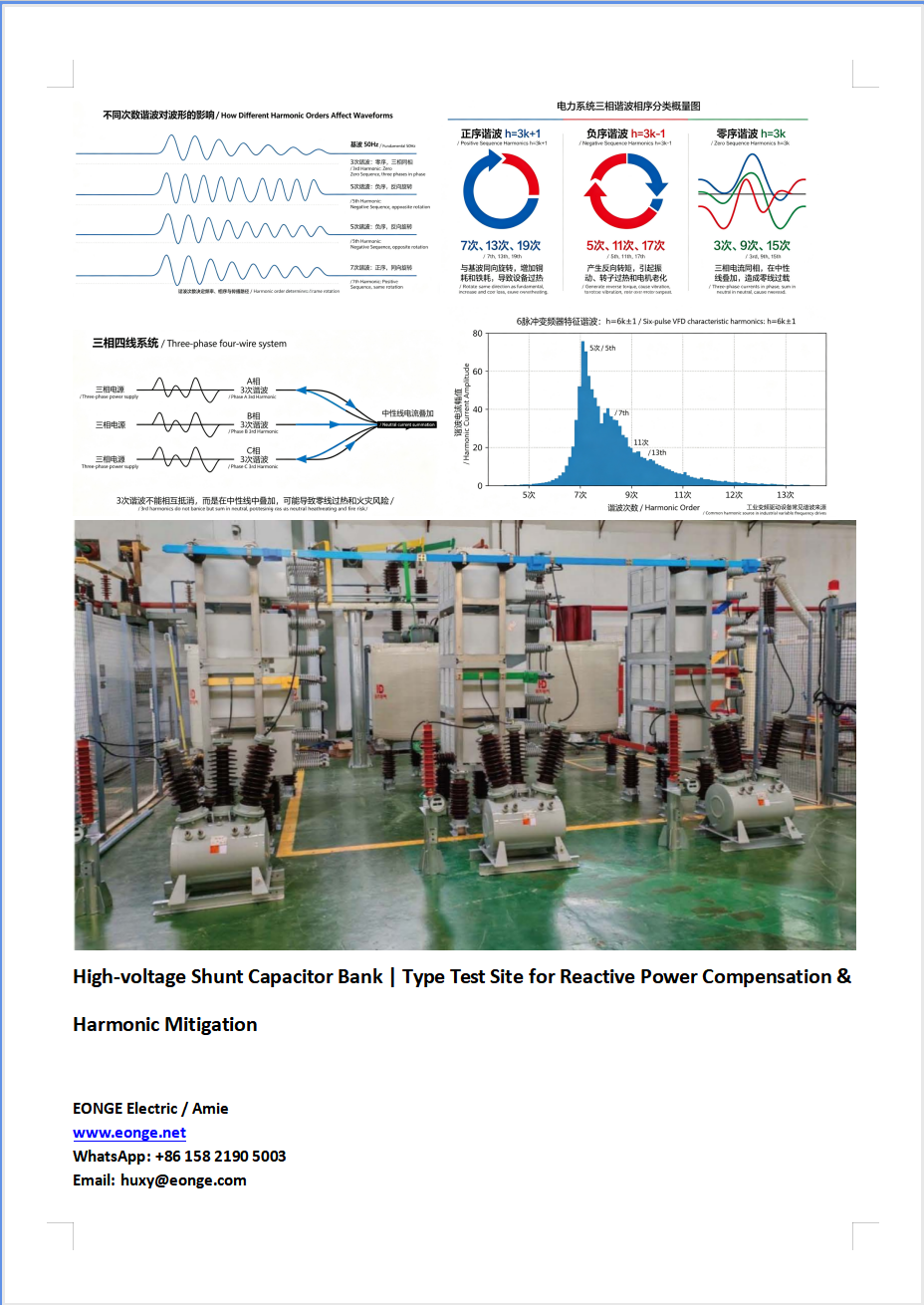
In a balanced three-phase system, harmonics follow a well-defined phase-sequence pattern:
| Harmonic Order | Formula | Sequence Type |
|---|---|---|
| 4th, 7th, 10th... | h = 3k + 1 | Positive Sequence |
| 2nd, 5th, 8th... | h = 3k − 1 (equivalent to 3k+2) | Negative Sequence |
| 3rd, 6th, 9th... | h = 3k | Zero Sequence (Triplen Harmonics) |
Each sequence interacts with electrical equipment distinctly.
Positive Sequence Harmonics (7th, 13th, 19th…)
- Rotate in the same direction as the fundamental rotating field
- Increase copper losses and core losses
- Introduce extra thermal stress in motors and transformers
Main impact: Lower system efficiency and overheating.
Negative Sequence Harmonics (5th, 11th, 17th…)
- Generate rotating fields opposite to the fundamental
- Create reverse braking torque and torque pulsations
- Cause rotor overheating, vibration, and accelerated motor ageing
Main impact: Premature degradation and shortened service life of rotating machinery.
Zero Sequence Harmonics (3rd, 9th, 15th… Triplens)
- Currents across all three phases are in phase
- Sum algebraically in the neutral conductor instead of cancelling out
- Lead to neutral overload and transformer overheating
Main impact: Neutral conductor overloading and elevated fire risk in 4-wire distribution networks.
Key Practical Insights
- Six-pulse VFDs produce characteristic harmonics following the rule \(h=6k\pm1\), mainly the 5th, 7th, 11th and 13th orders.
- Single-phase nonlinear loads such as SMPS, LED drivers, computers and UPS are common sources of 3rd harmonics.
- Delta-connected transformer windings offer a closed loop for triplen harmonic currents to circulate internally, limiting the flow of zero-sequence harmonics onto upstream supply feeders.
- Line-to-line voltages contain no zero-sequence components.
- This explains why THD measured on line-line voltages (THDV L-L) is normally lower than phase-neutral THDV (L-N).
The harmonic order determines not only frequency, but also rotational sequence, propagation path, and severity of disturbance to the power network.
Discussion Question
What is the highest THDi value you have measured in an industrial facility?
Recommended Products
The variety of models, to meet the development needs of various regions in the world.
Copyright © Shanghai Yongjin Electric Technology Co.,Ltd.

China Power Quality Solutions Supplier